Safety & compliance
Safety switch installation in Sydney's Eastern Suburbs
RCD installation and testing: the device that cuts the power when it detects current leaking to earth.
- NSW licence 237173C
- Quoted before work starts
- 5.0 from 139 Google reviews
In short
Ambient Electrical does safety switch installation, testing and repair in Sydney's Eastern Suburbs, either at the switchboard to cover whole circuits or at a single power point. A safety switch, or residual current device (RCD), turns the power off in a fraction of a second when it detects electricity leaking to earth at a harmful level, typically 30 milliamps or less. The NSW Government recommends testing safety switches twice a year.
- Who
- Peter Stafford, NSW contractor licence 237173C (Electrician class)
- Where
- Sydney's Eastern Suburbs, from Bronte
- Price
- Peter gives you a clear quote before any work starts.
- Paperwork
- NSW law requires a CCEW for this work, and the eCert portal sends you a copy (what a CCEW is)
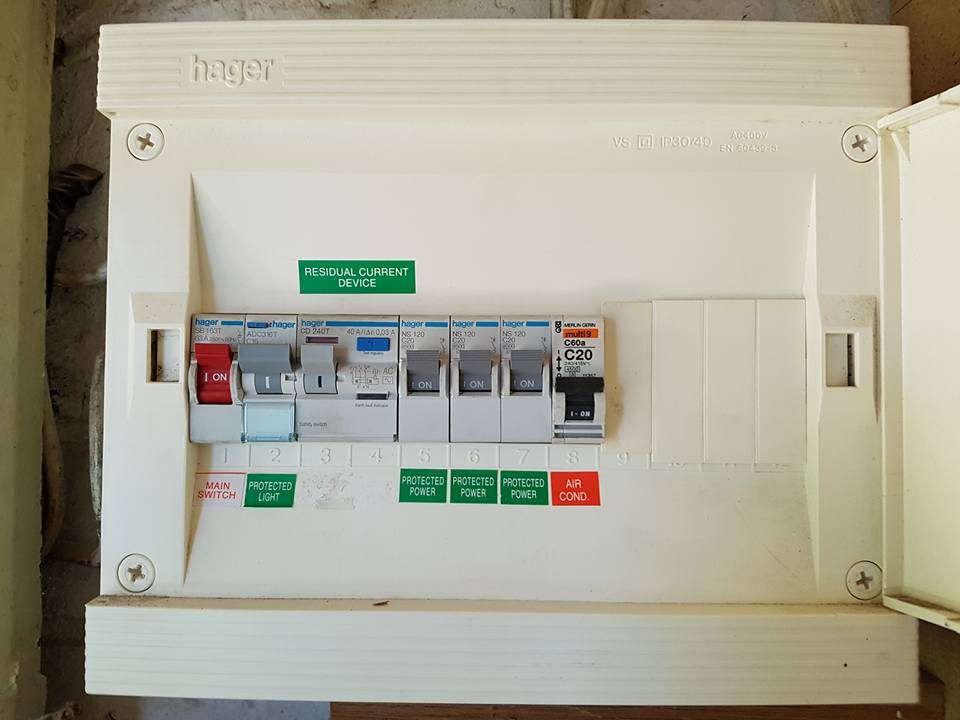
Safety switches are vital in protecting people against electrocution. They are required on light and power circuits and can be fitted to existing installations.
A safety switch, or residual current device (RCD), watches the current going out and coming back on a circuit. When it detects electricity leaking to earth at a harmful level, typically 30 milliamps or less, as happens when current flows through a person or through a fault to earth, it turns the power off in a fraction of a second.
Ambient Electrical installs, repairs and tests safety switches to the Australian Standards, using switches made by Hager, NHP and Clipsal.
Safety switches can be retrofitted to almost any installation: at the switchboard, protecting every light and power circuit, or on a single power circuit, protecting that point and everything beyond it.
The Wiring Rules (AS/NZS 3000) require a home with more than one final sub-circuit to have at least two safety switches, so that one fault does not black out the whole house.
| Device | What it protects | How it works |
|---|---|---|
| Rewireable (ceramic) fuse | The wiring, against overload and short circuits | A fuse wire melts when too much current flows. It does nothing to protect a person from an electric shock, and blown fuses are often rewired with the wrong gauge of wire. |
| Circuit breaker | The wiring, against overload and short circuits | Switches the circuit off when too much current flows, and is switched back on rather than rewired. On its own it does not protect a person from an electric shock. |
| Safety switch (RCD) | People, against electric shock | Compares the current going out with the current coming back, and turns the power off in a fraction of a second when electricity leaks to earth at a harmful level, typically 30 milliamps or less. |
Source: NSW Government: Electrical safety in the home; SafeWork NSW: Managing electrical risks in the workplace, code of practice (PDF). Fuse and circuit breaker rows: Peter Stafford's switchboard page.
Safety switch testing
The NSW Government recommends testing safety switches twice a year: press the TEST button on each one and it should switch off straight away. Push it back on and you are done. If it does not trip, it is not protecting you and needs replacing. An electrician tests more thoroughly with an instrument that applies a controlled fault current and measures how fast the switch operates. (Source: NSW Government: Electrical safety in the home)
In a rental, NSW Fair Trading treats a faulty safety switch as an urgent repair. Safety switches can only be installed by a licensed electrician. If yours keeps tripping, start with the appliances on that circuit.
What a customer says about this work
We called Ambient Electrics for what we thought was a small problem. Peter arrived on time and was very friendly. It turned out that we had a serious problem, the safety switch was not connected.We were horrified to think of the times when we could have been electrocuted.Peter explained every step in terms we could understand.If you need an electrician who is professional,congenial and honest we could not recommend Peter highly enough.
Sources
Where this work suits the local housing most: Bronte, Randwick, Kensington, Rose Bay, Bellevue Hill and Maroubra. Postcodes and councils for the areas we cover.
Safety switches: common questions
What does a safety switch do?
A safety switch, or residual current device (RCD), turns the power off in a fraction of a second when it detects electricity leaking to earth at a harmful level, typically 30 milliamps or less. That is fast enough to prevent a fatal electric shock, and safety switches have greatly reduced injuries and deaths from electrocution.
Can I install a safety switch myself?
Safety switches can only be installed by a licensed electrician. They can be retrofitted to almost any installation, either at the switchboard to protect every light and power circuit, or at a single power point. Ambient installs, repairs and tests them to Australian Standards. More on DIY electrical work in NSW.
How often should I test my safety switches?
The NSW Government recommends testing safety switches twice a year: press the TEST button on each one and it should switch off straight away. If it does not trip, it is not protecting you and needs replacing.
Will I get a compliance certificate when a safety switch is added?
Adding a safety switch alters the installation, so NSW law requires a compliance certificate (CCEW), lodged within 7 days, with a copy sent to you.
What affects the cost of adding safety switches?
The cost of adding safety switches depends on how many circuits need protection, whether the existing board has room for them, and whether an old board has to be replaced first. Peter checks the switchboard and gives you a clear quote before any work starts.
Last updated
Guides on this
Safety switch, circuit breaker or fuse: what each one does
A fuse and a circuit breaker protect the wiring: each cuts the power when too much current flows, from an overload or a short circuit.Do you need to rewire your house? Signs of old wiring
A house may need rewiring if it still has the cloth- or rubber-insulated cable found in many Sydney homes built between the 1890s and the 1970s.Power point not working? What to check first
First plug in something you know works, and check the power point's own switch is on.
Available 24/7
Something not working?
Call Peter directly. No call centre, no third party, and a clear quote before any work starts.
